
Your Animal Knows
What your dog or cat’s wellbeing might be telling you - and why it matters more than you think

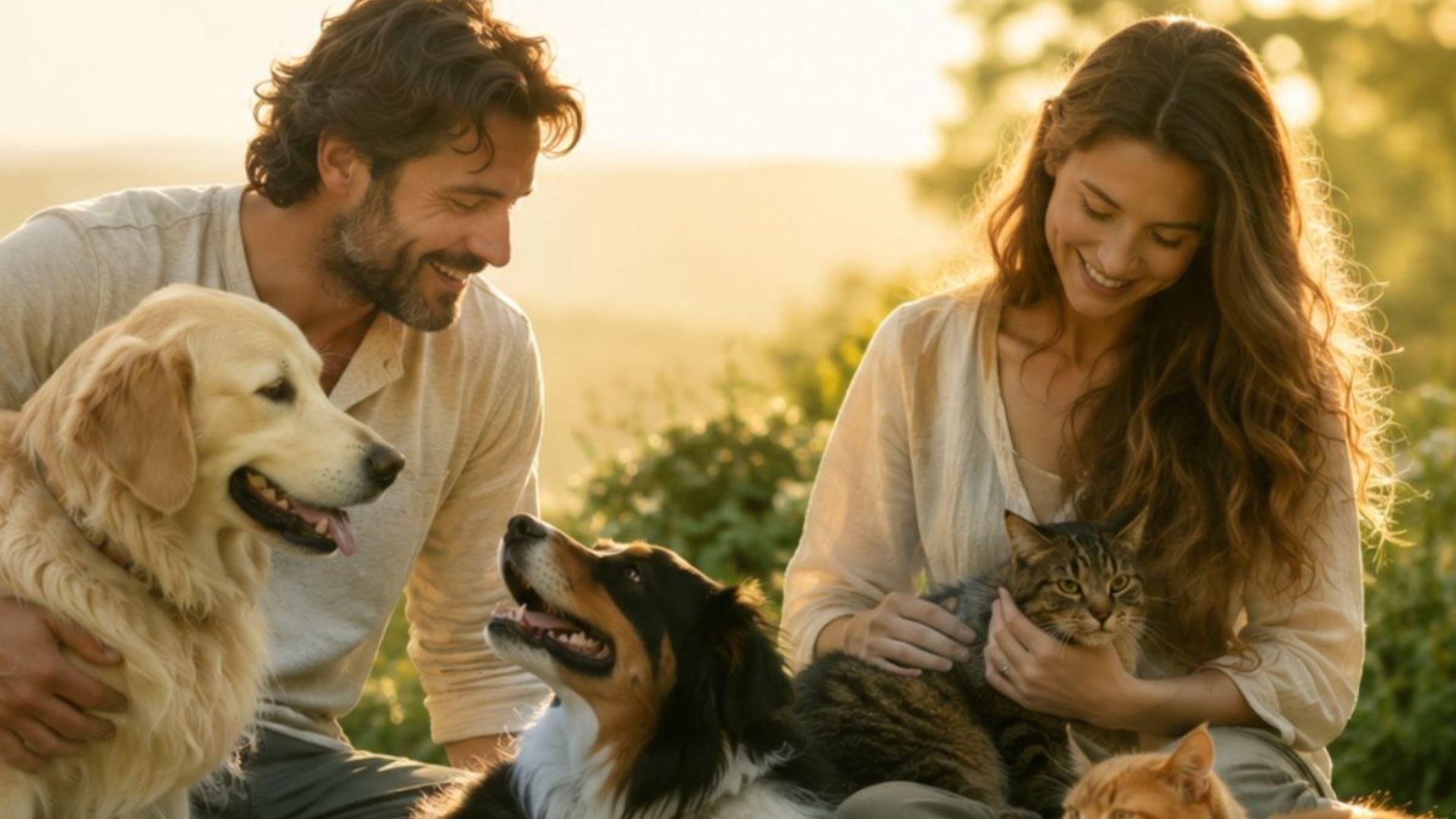
Something is happening with our animals.
If you spend any time in the world of pet care - whether as an owner, a practitioner, or simply someone who pays attention - you’ll have noticed it. Dogs who are anxious without obvious cause. Cats who withdraw or overgroom. Skin that flares, ears that itch, paws that are chewed raw. Digestive systems that struggle. Nervous systems that seem permanently on edge. According to recent insurance data covering more than two million pets, anxiety-related claims among dogs and cats have risen by 93% since 2019 alone. In some parts of the world, the increase is closer to 150%.
These are not small numbers. Something is shifting.
The mainstream response has been to look for physical causes - dietary triggers, environmental allergens, breed predispositions, hormonal imbalances. And these are real and worth investigating; I’ll come back to that. But for many animals, the physical explanations don’t fully account for what’s being seen. The tests come back inconclusive. The treatments manage but don’t resolve. The condition keeps returning, or shifting shape, or deepening. The animal is clearly suffering and nobody quite knows why.
I want to offer a different lens. Not instead of the physical - alongside it.
Animals are vibrational beings
Animals don’t navigate the world through thought and language the way humans do. They are exquisitely sensitive to vibration - to the quality of energy present in their environment and in the people they live closest to. This isn’t a poetic way of describing emotional sensitivity. It’s a description of how they actually work. They read frequency before they read behaviour. They feel what is present in the field around them long before any outward sign of it appears.
Dogs and cats in particular - our domestic companions - live inside the energetic field of their human families in a way that wild animals do not. Wild animals stay largely within their own natural alignment. Domesticated animals, by contrast, are woven into ours. They absorb our emotional states, carry stress that isn’t theirs, and respond to our inner weather in ways that can be profound and, at times, deeply telling.
Research into the human-animal bond has documented the stress-mirroring effect in measurable ways - cortisol levels in dogs have been shown to track closely with those of their owners over time. But beyond the biochemical, anyone who works with animals at an energetic or intuitive level will recognise something even more direct: the animal is often expressing, in its body and behaviour, something that the human is holding but has not yet fully acknowledged.
The anxious dog whose owner is quietly overwhelmed. The cat who stops eating when its human is grieving. The dog with chronic skin inflammation whose owner has been living with unaddressed stress for years. These are not coincidences. They are the bond doing what it does - transmitting, reflecting, asking to be seen.
What they are here to do
I believe - and this is rooted in two decades of working with animals, as well as in a broader understanding of consciousness and wellbeing - that our domestic animals are companions on a soul level, not only in the worldly sense. They choose us, or we choose each other, for reasons that go beyond practicality or preference. They arrive into our lives at particular moments. They stay for the time they are needed. They reflect back to us, with extraordinary honesty, where we are.
Their capacity for unconditional love is unlike almost anything else in ordinary human experience. A dog will orient toward your joy and do whatever it can to help you find your way back to it when you’ve lost it. It doesn’t withhold. It doesn’t keep score. It is genuinely, wholeheartedly on your side. (Cats, I will say with affection, offer a version of this that is rather more selective - but if you have earned a cat’s devotion, you will know there is nothing quite like it.)
This quality - the natural orientation toward wellbeing, the absence of the resistance and self-commentary that humans carry - is itself a teaching. Our animals live closer to their natural state than we do. When they are well, they show us what ease looks like. And when they struggle, they often show us where we are not yet at ease ourselves.
Why generic solutions are less effective than they used to be
We are living through a period of significant collective change. The way I understand it - and this applies to humans and animals both - is that we are increasingly being called to take responsibility for our own unique energy, our own bodies, our own inner environment. The era of one-size-fits-all solutions is giving way to something more individual, more subtle, more attuned to the specific being in front of you.
This doesn’t mean conventional approaches have no value - they do, and working with a good vet remains important and I would always encourage it. But it does mean that for a growing number of animals (and humans), the generic approach reaches its limit. The same protocol that helped the last dog doesn’t help this one. The medication manages the symptom without touching the source. There is something that needs to be met at a different level.
Diet is one place where this is immediately practical. Highly processed foods create inflammation in the body - and in dogs and cats, this often shows up as itchy skin, sore paws, and recurring ear problems. These are among the most common presentations I see, and they frequently improve significantly when food quality improves. If you’d like to talk about what your animal is eating, that’s always part of the conversation.
Vibrational healing for animals - and for the bond itself
Flower essences are preparations made from the energetic signature of plants. They work at the level of feeling and consciousness rather than biochemistry - addressing the emotional and energetic patterns that underlie physical conditions rather than the conditions themselves. They are gentle, non-toxic, and can be used alongside any other treatment without interference.
What the deeper tradition of flower essence work understands about animals is something I find both practically useful and quietly extraordinary: the essences don’t only work on the animal in isolation. They work on the bond. Because the human’s own vibrational state is always present in the field the animal inhabits, shifting that state is often as important as any direct treatment. Some essences are given to the animal and the human together, because the healing of the animal flows partly through the quality of the connection between them.
When the human is in a clearer, more aligned state - when they are able to hold a picture of their animal as well rather than bracing against their illness - the animal responds to that shift. The human is never truly separate from the animal’s condition. Which is both the challenge of this work, and the most powerful aspect of it.
What I offer
When you come to work with me around your animal’s wellbeing, what I’m offering first is a quality of attention - the sense of being genuinely met and understood, for you and for your companion. I’m not here to override the work of your vet or to offer certainty I don’t have. I’m here to offer a perspective that holds the energetic and spiritual dimensions of the relationship alongside the practical, and to work with you to find what feels right and true for your specific animal, in your specific life, at this specific moment.
From that, we might arrive at a bespoke flower essence blend for your animal, or for you both. We might look at the patterns present in the relationship and what they’re asking for. We might talk about food, about daily rhythms, about what the animal’s behaviour has been trying to tell you.
A consultation for your animal is, in the best sense, also a consultation for you. Not in a way that makes the animal’s struggle about you - it isn’t - but in a way that recognises you are in this together, that the vibrational field between you is real, and that working with it consciously opens possibilities that treating the animal alone cannot reach.
If something in this has resonated - if you’ve read this and recognised your dog, your cat, or yourself in it - I’d invite you to be in touch. You can also download the free guide below, which maps some of the most common behavioural patterns in dogs and cats to what they often reflect in their human companions. It’s a place to begin.
Your animal already knows. This work is simply about learning to listen.
………………………..
Paul Sawyer is the founder of Aligned Harmony and has worked with animals and their owners for over twenty years, drawing on flower essence therapy, energetic healing, and the Conscious Becoming framework.